
 United Kingdom
 China
China Hong Kong SAR
 India
India Indonesia
 Japan
Japan Malaysia
 Qatar
Qatar Singapore
 South Africa
 Thailand
 Turkey
Who's buying in Dubai - 2025 recap
Dubai's buyer base in 2025 was more diversified than at any point in its history.
Property advice | 13.03.2026 | Leanne Ruscoe
The 2025 property market in Dubai is shaped by global capital rather than just speculation, with India, the UK, China, and Saudi Arabia leading the diverse and long-term buyer base.
Dubai's buyer base in 2025 was more diversified than at any point in its history. The motivations behind capital inflows now stretch far beyond short-term gains, signifying fiscal repositioning, wealth preservation strategies and lifestyle migration. Based on Dubai Land Department transaction insights and brokerage analysis of DLD data, the top five buyer nationalities in the previous year were:
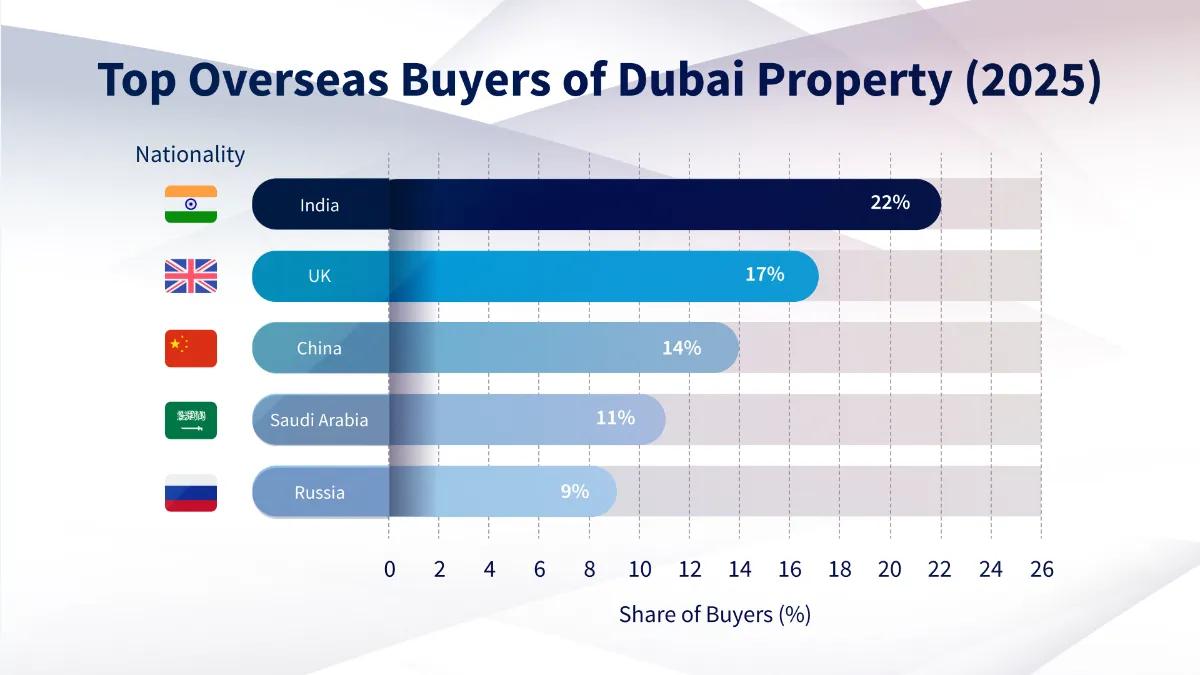
These rankings generally match the transaction insights shared in 2024-2025 by leading real estate brokerages using Dubai Land Department data. Although the DLD does not publicly release exact real-time nationality percentages, annual market reports consistently show India and the UK occupying the top two spots, with China's strong comeback standing out as a key trend in this cycle.
India: Long-term commitment over short-term yield
By increasing its share from 21% in 2024 to 22% in 2025, India successfully continues to dominate the Dubai property market. However, the real story lies in the transitional shift of intent. Indian buyers are no longer just being yield-focused investors and focusing on rental returns. For a long period, Indian buyers have seen Dubai as a destination for long-term residency, while many buying homes as primary residences or family bases alongside investment properties.
Several push factors are responsible for driving this outward capital movement, including currency diversification, wealth creation through India's equity and entrepreneurial growth, and high real estate valuations in key metropolitan cities.Simultaneously, the UAE's Golden Visa program for property investors, no-income tax system, and excellent transportation between major Indian cities and Dubai have made relocating more appealing. This shift from investor-led to residency-driven acquisition in Dubai's buyer ecosystem represents a significant change in structure.
United Kingdom: Fiscal repositioning and lifestyle arbitrage
The UK comes in second with 17% of all transactions, showing its highest participation in years. The rise in British demand is partly driven by recent UK tax reforms, including the abolition of the non-domicile tax regime from April 2025, that has prompted many high-net worth individuals to reassess where they reside and invest. Wealthy people can find a good alternative in Dubai, with tax benefits and high rental yields.Beyond taxation, lifestyle remains a crucial factor. Waterfront villas, golf communities and branded residences are experiencing higher UK interest. Many purchases are structured as hybrid assets, partly as a wealth hedge, partly as a relocation or second-home strategy.
China: The defining return of 2025
China's 14% market share made it the comeback story of 2025. Following pandemic-era restrictions and subdued activity, the Chinese capital has returned to a scale. Ongoing tension in China's property sector, including the well-known debt crisis faced by developers like China Evergrande Group, has motivated many investors to diversify overseas, with Dubai emerging as a stable and secure option.
Also, stronger trade relations between the UAE and China, along with more direct flight connections, have made investing in Dubai an easy choice.
Saudi Arabia: High-value capital
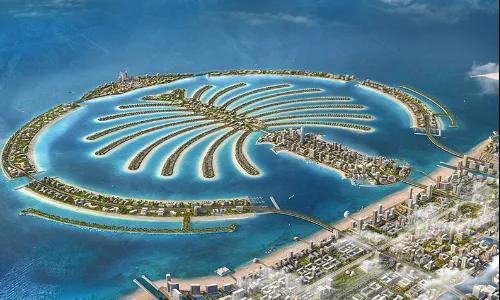
Saudi Arabia accounts for 11% of the market and stands out for having one of the highest average ticket sizes among major nationalities. Saudi buyers are especially active in prime communities such as Palm Jumeirah and Dubai Hills Estate, targeting luxury villas and expansive residences.
Proximity, cultural knowledge, and travel convenience strengthen this route. Dubai complements Saudi Arabia's growth narrative by offering a mature luxury ecosystem and international schooling, healthcare, and hospitality infrastructure, rather than competing with it.
Russia: From surge to stabilisation
Russian buyers, who came into the limelight following the Russia-Ukraine war, accounted for around 9% of transactions in 2025. While the activities have seen moderations from the surge in 2022 as many investors relocated capital during the conflict, demand stays particularly visible in ultra-prime and branded residential segments. Some buyers have also been exploring alternative payment methods, including the use of digital assets, reflecting a major shift towards flexible wealth transfer strategies and long-term capital preservation.
Can we expect a more diversified and resilient market?
As Dubai continues to draw homebuyers from around the globe, its property market is becoming visibly diverse. As a global business hub with robust infrastructure, tax advantages and lifestyle appeal, the city continues to attract professionals, entrepreneurs and investors looking for both residential stability and long-term revenue opportunities.
This global interest is reflected in the buyer mix. India and the UK remains at a top position among other nationalities, while China's return has strengthened international capital inflows. Saudi buyers are also becoming more visible, particularly in the luxury segment, highlighting the expanding global appeal of Dubai's real estate market.
.jpg?w=168&h=168)
View all posts by Leanne Ruscoe

Benham and Reeves UAE
BRITISH OWNED & OPERATED


AED 1,800,000
AED 2,350,000
AED 5,500,000
AED 679,999
AED 1,142,000